
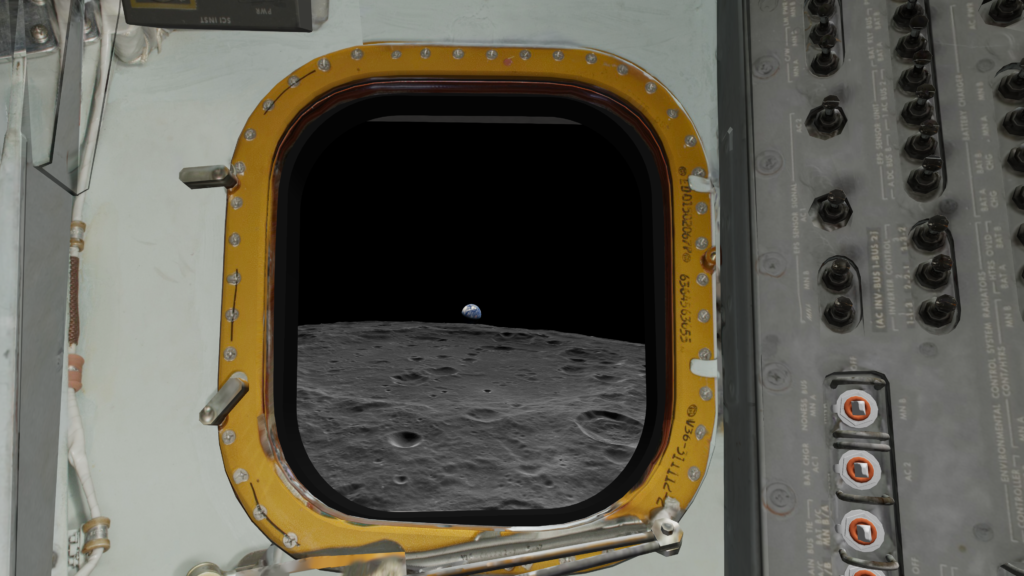
In May 2026, audiences around the world were invited to relive one of the most extraordinary chapters in human history. Once Upon the Moon, a new fulldome experience created by Visualiseringscenter C in Norrköping, combines authentic Apollo-era photographs and film footage, cutting-edge scientific visualization, and personal stories from astronauts to create an immersive journey unlike any previous retelling of the Moon landings.
More than half a century after humans first set foot on the lunar surface, the production offers something remarkable: the opportunity not only to learn about the Apollo missions, but to experience them from a new perspective.
An Idea Decades in the Making
The idea behind Once Upon the Moon has been with director Carter Emmart for decades. Widely recognized as one of the world’s leading fulldome filmmakers and formerly Head of Astrovisualization at the American Museum of Natural History’s Hayden Planetarium, Carter has devoted much of his career to helping people understand the universe through immersive visual experiences. The project also reflects a long-shared vision with executive producer Anders Ynnerman, professor of scientific visualization at Linköping University, founder of Visualiseringscenter C, and one of the main driving forces behind the WISDOME-initiative.
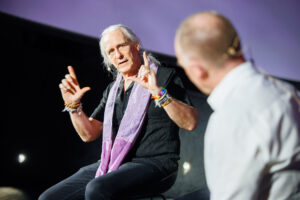
Carter Emmart and Anders Ynnerman on stage at the premiere of Once Upon the Moon in Gothenburg in May 2026. Photo: Thor Balkhed, Linköping University.
As passionate astronomy and spaceflight enthusiasts, Carter and Anders have spent many years discussing how emerging visualization technologies could bring the story of lunar exploration to new audiences. The opportunity to transform those conversations into reality came when Carter joined Visualiseringscenter C and Linköping University through the Peter Wallenberg Jr Guest Professorship in Visual Science Communication. Working closely together, they began developing a production that would combine scientific accuracy, historical authenticity, and state-of-the-art visualization in a way that had never before been attempted.
Their ambition was not simply to retell the story of the Apollo missions, but to recreate them as lived experiences. By combining archival photographs and film footage with scientific data and personal testimony from astronauts and researchers, the production seeks to transport audiences back to an era when humans first ventured beyond Earth. Viewers are invited to relive what it felt like to travel nearly 400,000 kilometers through space and descend onto the lunar surface.
The fulldome format plays a crucial role in achieving this vision. Unlike traditional cinema, where audiences observe events through a rectangular screen, the dome surrounds viewers with imagery in every direction, creating a powerful sense of presence and scale. Combined with data-driven visualizations and authentic Apollo material, this immersive environment allows audiences to experience the vastness of space, the stark beauty of the lunar landscape, and the challenges faced by the astronauts in a uniquely direct and emotional way. Once Upon the Moon is the realization of Carter and Anders’ shared ambition: to harness the storytelling power of immersive technology and allow a new generation to experience humanity’s journeys to the Moon as never before.
Reconstructing the Moon with data visualization
At the heart of the production lies OpenSpace, a powerful visualization platform developed by Linköping University and Visualiseringscenter C in collaboration with institutions including the American Museum of Natural History and the University of Utah. OpenSpace is already used by researchers and planetariums worldwide to visualize astronomical data and communicate complex scientific ideas. For Once Upon the Moon, however, the software was pushed into new territory as a production tool.
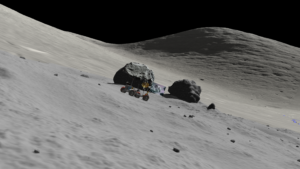
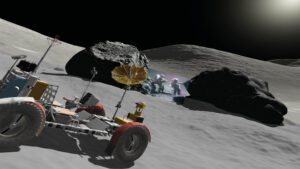
The lunar rover on the moon visualized via OpenSpace.
Using detailed mapping data from the Lunar Reconnaissance Orbiter (LRO), which has surveyed the Moon’s surface in extraordinary detail, the production team reconstructed the lunar environment with exceptional accuracy. During targeted passes in lower lunar orbits, LRO imagery can achieve resolutions of around 25–30 centimeters per pixel, sharp enough to reveal Apollo-era equipment left on the surface, as well as the tracks made by the astronauts’ lunar rovers. This level of detail proved invaluable for Once Upon the Moon. By combining the orbital data with information about the astronauts’ actual movements during the missions, the team was able to place a digital 3D model of the Lunar Roving Vehicle along the precise traverses driven during Apollo 15, 16, and 17. The result is a scientifically grounded reconstruction that allows audiences to follow the astronauts’ journeys across the Moon exactly as they unfolded more than fifty years ago.
The result is something extraordinary. Viewers can follow the precise routes taken by astronauts as they explored the Moon’s surface, driving lunar rovers across craters and valleys that have been digitally recreated from real scientific measurements. Perhaps even more impressive, photographs and film footage captured during the missions were mapped directly onto the correct locations in the lunar terrain. Scenes recorded more than fifty years ago appear exactly where they happened, allowing audiences to understand not only what the astronauts saw, but also where they were and how the photos and videos relate to the broader lunar landscape.
This creates a unique form of mixed reality, where historical archive material merges seamlessly with modern scientific visualization. The approach provides a sense of scale and context that was impossible during the original broadcasts of the Moon landings.
Voices from the Moon
A central feature of Once Upon the Moon is the inclusion of interviews with people who experienced lunar exploration firsthand. Among them is Apollo astronaut Charlie Duke, one of only twelve humans to have walked on the Moon. During Apollo 16 in 1972, Duke spent more than twenty hours on the lunar surface, much of that time exploring using the lunar rover. When shown visualizations from the production, Duke reportedly began recalling vivid memories from his mission. The digital reconstructions helped trigger personal stories and reflections that bring an intimate human dimension to the film.

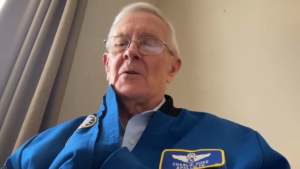
Apollo astronauts Jack Schmitt and Charlie Duke are interviewed for Once Upon the Moon.
The production also features Apollo astronaut Harrison Schmitt, often known as Jack Schmitt. As the only geologist ever to walk on the Moon, Schmitt offers a unique scientific perspective on the Apollo program. His insights reveal how lunar rocks and landscapes preserve clues to the early history of the Earth-Moon system and, by extension, the origins of our own planet. Together, Duke and Schmitt provide rare firsthand accounts from a generation whose achievements remain unmatched.
From Apollo to Artemis
While Once Upon the Moon looks back at the Apollo era, it is equally concerned with the future. The production includes interviews with astronaut Christina Koch, who represents a new generation of explorers helping to shape humanity’s return to the Moon through NASA’s Artemis program. Her reflections connect Apollo’s legacy with the scientific and technological ambitions of future lunar missions. The film also features Swedish astronaut Marcus Wandt, who traveled to the International Space Station in 2024.
For producer and scriptwriter Anna Öst, connecting these different generations of explorers was a central goal of the production. While the Apollo missions remain one of humanity’s greatest achievements, they are increasingly becoming history for younger audiences who did not experience them firsthand. By weaving together stories from the astronauts who walked on the Moon with voices from those preparing to return there, the production seeks to place Apollo within a larger and still-unfolding story of exploration.
“The Moon landings inspired an entire generation,” Anna explains. “Today, many young people know about Apollo, but they did not witness it firsthand. We wanted to create a story that not only looks back at what was accomplished, but also shows how those achievements continue to influence science, technology, and space exploration today. By connecting the pioneers of Apollo with the astronauts of Artemis, we hope to inspire the next generation of explorers, engineers, researchers, and dreamers.”

Producer and scriptwriter Anna Öst. Photo: Thor Balkhed, Linköping University.
By placing Apollo veterans and modern astronauts side by side, Once Upon the Moon highlights a powerful continuity: the same spirit of curiosity that drove the Moon landings continues to inspire new generations of explorers. In many ways, the film serves as a bridge between those who journeyed to the Moon in the twentieth century and those working to return there in the twenty-first, reminding audiences that exploration is not a completed chapter of history, but an ongoing human endeavor.
The Hasselblad Connection
The project also carries a uniquely Swedish dimension.
Funding for Once Upon the Moon was provided by the Hasselblad Foundation, whose involvement reflects the central role that Swedish innovation has played in humanity’s exploration of space. Founded in Gothenburg, Hasselblad became part of one of the greatest technological achievements of the twentieth century when specially modified Hasselblad cameras accompanied Apollo astronauts to the lunar surface.
These cameras captured many of the most iconic images ever taken—from astronauts working against the stark lunar horizon to the famous photographs of Earth seen from space. The images not only documented humanity’s first journeys to another world, but also transformed how people on Earth viewed both the Moon and their own planet.
For a Swedish production such as Once Upon the Moon, the connection is particularly meaningful. The project brings together two Swedish strengths: a long tradition of technological innovation and world-leading expertise in visual storytelling and scientific communication. Just as Hasselblad’s cameras helped bring the Apollo missions into homes around the world more than fifty years ago, Once Upon the Moon uses cutting-edge visualization technology developed at Linköping University and Visualiseringscenter C to allow audiences to experience those journeys in an entirely new way.
The Hasselblad Foundation’s support reflects its long-standing commitment to initiatives that unite science, technology, education, and image-making. In many ways, the production continues the legacy of the Apollo photographs themselves. The same images that once allowed millions of people to witness the Moon landings are now integrated into immersive scientific visualizations, placing audiences within the lunar landscape and providing a deeper understanding of where those historic moments unfolded.
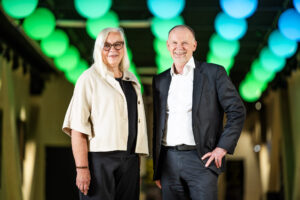
Many thanks to the Hasselblad Foundation for its generous contribution to the production. Chairwoman of the Hasselblad Foundation Christina Backman and Professor Anders Ynnerman. Photo: Thor Balkhed, Linköping University.
A Collective Journey to the Moon
Like the Apollo program itself, Once Upon the Moon is the result of a remarkable collaborative effort. Bringing together historical archives, scientific research, advanced visualization technology, sound design, animation, music, and storytelling required contributions from specialists across many disciplines and institutions.
Behind the immersive experience lies years of technical and creative work. Artists, developers, visual effects specialists, researchers, data analysts, editors, and 3D modelers worked together to reconstruct the Moon and the Apollo missions with a level of detail that would have been impossible only a few years ago. The production team combined information from lunar orbiters, astronaut transcripts, mission archives, scientific studies, and historical photographs to create a scientifically grounded yet emotionally engaging experience.
Many contributions were essential in bringing the story to life. Space artist Don Davis created visualizations of the Saturn V launch, the astronauts’ departure from the Moon, and illustrations depicting the Moon’s geological history. Archive producer Stephen Slater helped source and curate historical Apollo film and video material, while planetary scientist Jacob Kegerreis contributed simulations showing how the Moon may have formed billions of years ago. Torie Rosebourgh and the Lunar Reconnaissance Orbiter Camera Team provided expertise and data essential for the production.
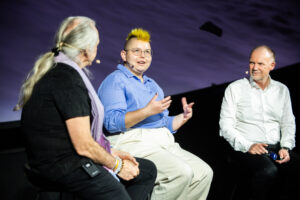
Torie Rosebourgh from the Lunar Reconnaissance Orbiter Camera Team on stage at the premiere. Photo: Thor Balkhed, Linköping University.
The production’s meticulous reconstructions also benefited from the work of visual effects artist Paul Fjeld and Academy Award-winning visual effects supervisor John Knoll. Together they contributed analyses and reconstructions of Apollo 15’s landing trajectory, while John also provided the detailed 3D model of the Apollo 15 Lunar Module used in the production.
A key role was played by the OpenSpace software platform and the many students, developers and researchers who have contributed to its growth over the years, led by Alexander Bock and supported through the efforts of the OpenSpace development team. Their work made it possible to transform vast amounts of scientific data into visual experiences that audiences can explore and understand. Development of OpenSpace for this production was supported by the Swedish e-Science Research Center, whose contribution helped advance the tools needed to create the film’s unique visualizations.
The project also stands on the shoulders of a much larger community dedicated to preserving and understanding the history of lunar exploration. The Apollo Lunar Surface Journal and Apollo Flight Journal were indispensable resources throughout the production, with special gratitude to Eric M. Jones for his decades of work documenting and preserving the Apollo missions. The filmmakers also acknowledge the inspiration provided by geologist Don Wilhelms, whose pioneering studies of lunar geology helped shape our understanding of the Moon, and software engineer Ben Feist, whose work has enabled new generations to explore and experience the Apollo missions in unprecedented detail.
Finally, the production would not have been possible without the support of organizations committed to advancing science, education, and visual storytelling. Generous funding from the Hasselblad Foundation and the Knut and Alice Wallenberg Foundation made it possible to bring together the expertise, technology, and creative talent required to realize the project.
Experiencing History in a New Way
The Moon landings have been documented in books, documentaries, and museums for decades. Yet Once Upon the Moon offers something fundamentally different.
By combining authentic astronaut testimony, historical photographs, scientific research, and immersive dome technology, the production transforms a familiar story into an experience. Audiences are not merely told what happened; they are invited to witness it within the context of the actual lunar landscape.
In doing so, the film highlights the growing role of scientific visualization as a tool for both research and public engagement. Data that once existed only in scientific archives can now be transformed into compelling visual narratives that make complex discoveries accessible to broad audiences.
More than fifty years after humans first walked on the Moon, Once Upon the Moon reminds us that exploration is not only about reaching new worlds. It is also about finding new ways to understand and share the journeys that changed our understanding of our place in the universe.
As humanity prepares to return to the Moon, this remarkable fulldome production offers a timely opportunity to revisit where the story began—and to imagine where it may lead next.