
Space is unimaginably vast. Thanks to our curiosity and quest for knowledge, we humans have been driven to explore space and learn more about the universe. There is still incredibly much left to explore.
In the dome show VAST, narrated by, we embark on a journey further into space than any human has ever been. Everything we see on our journey is based on real scientific data gathered thanks to humanity’s technological advances and many years of research. Join us on the journey, starting in our own solar system all the way to the Big Bang.
In the interactive software OpenSpace, which Visualization Center C has long developed together with, among others, NASA, all available astronomical data is visualized. In VAST, we want to convey a sense of how gigantic the universe is – and give an insight into how much we humans have actually found out about space. With visualization technology, we can today travel through the entire known universe – a really cool way to explore and experience with the help of scientific data.
The storyline for the film already exists with our live shows, where, among others, Professor Anders Ynnerman takes the audience on interactive journeys through space. The big challenge was using OpenSpace to make a movie. But we succeeded!
You will experience a journey to the outer limits of the universe. The production shows how, with the help of visualization, we can create an atlas of what our entire known universe looks like—we can travel from Earth, through the planets, out to galaxies and quasars, and all the way to the Big Bang. It becomes a reflective experience that invites contemplation of the grandeur of the universe. It also shows how fantastic it is that we humans, together through many years of research, have managed to learn so much about the universe around us.
Space as a theme sparks students’ natural curiosity and imagination, leading to questions about the origin of life, the size of the universe, and humanity’s place in the cosmos. The study of the universe naturally becomes an interdisciplinary learning experience—space encompasses physics, chemistry, biology, mathematics, technology, and even the humanities.
VAST can inspire learning about everything from gravity and how humans survive in space to sustainable resource use and the possibility of life on other planets. The exploration of space is also a part of our shared history and culture, from the first moon landings to dreams of reaching other galaxies.
Using VAST as a pillar of education provides both knowledge and inspiration, giving students the opportunity to challenge their perspectives on the future, technology, and the needs and development of humanity.
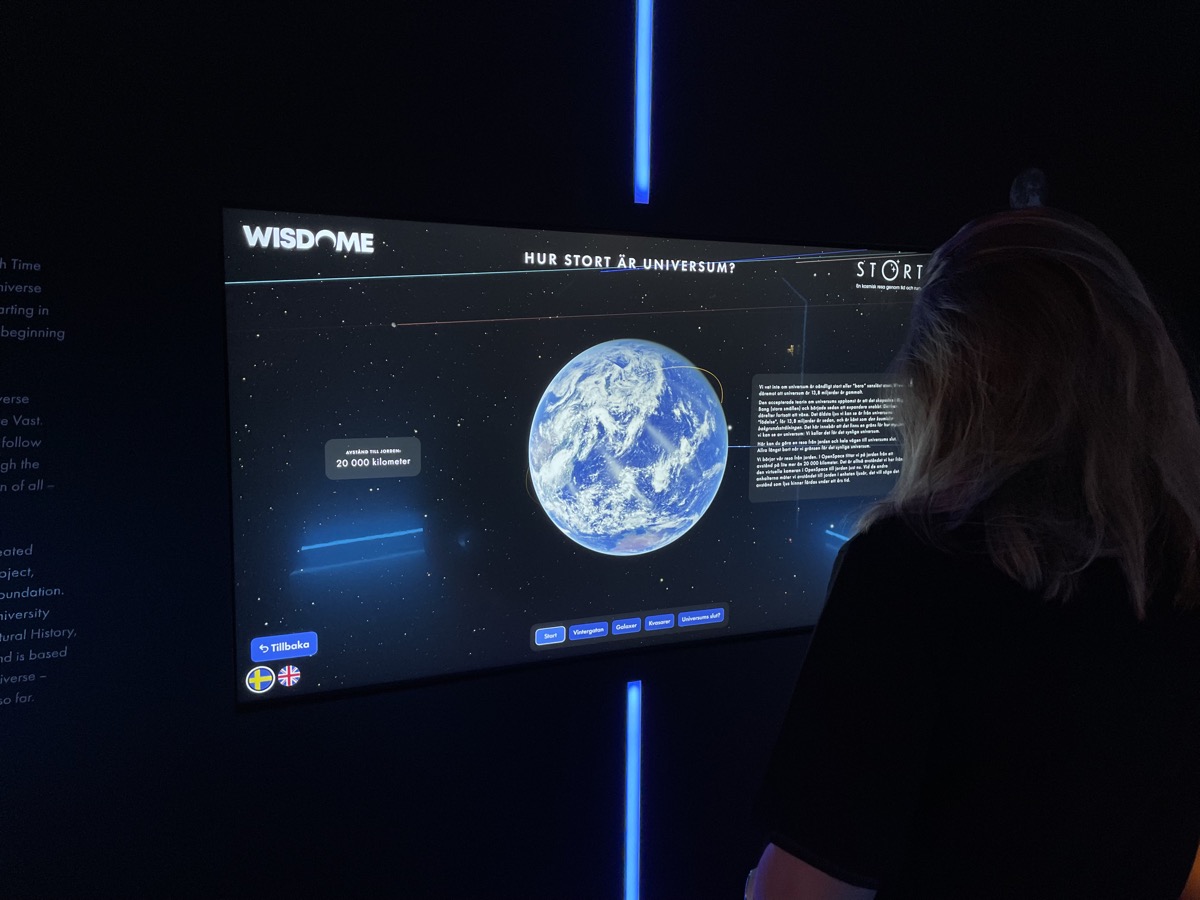
The dome production STORT has been created using OpenSpace. With the same software, you can explore space on your own—either from your home computer or at one of our science centers.
In the interactive installation, OpenSpace allows you to learn more about the different planets in our solar system. You can follow the Voyager spacecraft on its endless journey through the universe—or why not explore the biggest question of all: Is there life out there?
The installation has been created by Visualizationcenter C within the Wisdome project, with support from the Knut and Alice Wallenberg Foundation. OpenSpace is developed by Linköping University in collaboration with NASA, the American Museum of Natural History, and others. It is based on a scientifically accurate model of the entire known universe—everything we have been able to measure or observe so far.
The installation is available to view at our Science Centers. It is also possible to sign a license to use the installation at museums, science centers or in other educational contexts. Contact us for more information!